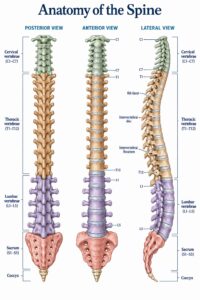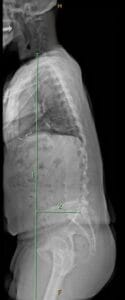
The normal spine is balanced with regards to the position of the head over the pelvis. This is true for the front view(coronal) plane and side view (sagittal plane). Scoliosis refers to abnormal curve of the spine in the coronal plane and these curves may be balanced or imbalanced where the head sits off to one side or the other compared to the centre of the pelvis. The spine has a normal curved shape in the sagittal plane. In the lumbar and cervical region there is a concavity at the back termed lordosis, whereas in the truncal or thoracic spine there is a convexity (kyphosis) to the spine at the back. Overall the head sits well balanced over the pelvis to neutralize the forces and the amount of work the spine muscles need to do to maintain upright posture.
Sagittal imbalance occurs when the spine cannot be maintained in an upright position without significant compensation from the hips or knees. It is important to understand that as the spine undergoes age related changes it loses much of the normal lordosis and there is a gradual trend toward kyphosis. This occurs because of disc degeneration that leads to loss of disc height more at the front than the back and with osteoporosis the spine can undergo spontaneous wedge fracture that also add to the kyphosis. This is a “normal” aging process and for most people causes no major symptoms apart from the bent posture. If the hips remain mobile then most spines self adjust by allowing extension of the pelvis through the hips.
The spinal extensor muscles (erector spinae) also work overtime to reduce any kyphosis. The constant activity in these muscles can lead to increased forces across the facet joints and degenerative arthritis. The erector spinae can also fatigue and cause muscle aching when trying to stand and walk. If the kyphosis is stiff then the pull of the muscles will not be effective and the muscles will fatigue more quickly.
However if the kyphosis becomes too much for the pelvic compensation mechanisms then there will be imbalance and hips and knees must flex to allow an upright position. This leads to inefficient use of the leg muscles and fatigue in these muscles also. Walking and standing can become very difficult and exhausting.
Patients with the sagittal imbalance syndrome rate their health very poorly and rate themselves similarly to patients with stroke, diabetes and cancer.
Thankfully if it can be recognised that the symptoms are the result of this deformity then a spinal correction can be helpful. A specialist spine deformity surgeon can assess your spine and evaluate your imaging to help understand your condition and work out how it might be corrected. Factors that may affect the decision making include your general health, bone quality and degree of disability. Because surgery may carry a significant risk of one or more complications, most surgeons would recommend non-operative treatments first, including a trial of a walking aid, use of simple pain killers and exercise to strengthen the spine muscles. The decision to have surgery is ultimately a shared decision between the patient and the surgeon and should involve a discussion about complications and set realistic outcome expectations.
The aim of surgery is to restore sagittal balance and thereby relieve pain and improve mobility and independence. Stiffness in the back is often mentioned by patients who have had long fusions for this problem but often tolerated better than the original pain and disability from the original condition.