Conditions treated
Osteoporotic compression fractures.
Osteoporosis is a condition characterised by loss of the mineral content of bone, leading to weakness of the bones. In the spine this means the vertebral body is most commonly affected.
Overview
Why the mid-back is most often affected.
The cancellous bone (spongy bone) is affected earlier than the cortical bone (compact bone), and in the spine this means the vertebral body is most commonly affected.
In particular, the vertebral bodies of the middle thoracic region and upper lumbar region are most typically affected because they are loaded in compression due to the normal kyphotic curve to this area of the spine.
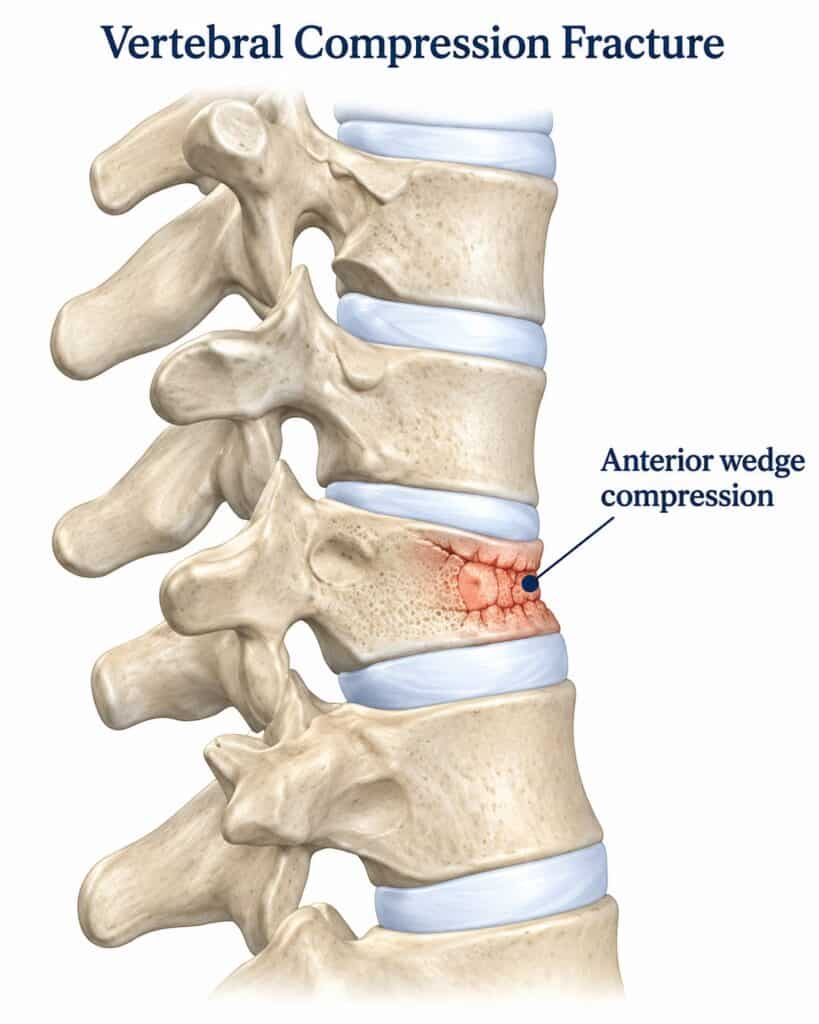
When the vertebral body fractures it tends to collapse into a wedge shape with most of the collapse at the front. These are often called wedge compression fractures. This compression tends to stabilise the spine, but over time and with multiple fractures it also leads to further kyphotic shape to the spine.
Treatment
How these fractures are treated.
Back pain is the most common reason patients seek medical attention. Thankfully the pain from an osteoporotic spine fracture does typically settle over a few weeks to a few months.
Symptomatic treatment
Treatment of the pain is largely symptomatic, with activity modification and simple analgesia.
Cement injection is controversial
Treatments that inject cement into the vertebra to reduce pain are controversial. Two recent large randomised studies have not shown any meaningful advantage to this type of treatment. There is also concern that cement can stiffen the spine and lead to further fractures elsewhere, and cement leakage is common and can rarely compromise the spinal cord or nerves.
Preventing further fractures
Whilst osteoporosis is in many ways a natural consequence of ageing, a number of conditions can accelerate normal age-related bone loss and some have specific treatments. Your doctor may need to do some tests to look for these.
Medication and surgery
What happens after a fracture.
After an osteoporotic spine fracture, most patients would be recommended to take medication to slow down bone loss. There are many agents on the market that can do this, and your general practitioner should be able to recommend the best treatment depending on your circumstances.
Spinal surgery rarely has a role in the management of this type of fracture.
Living with back, neck or joint pain?
Dr David Edis and the team at Victorian Orthopaedic Spine Service will assess your symptoms, explain your diagnosis and recommend the treatment that best suits you.
Get in touch
Contact our rooms.
Our reception team will help you arrange a consultation, answer questions about your referral and let you know what to bring on the day.
Reception hours: Monday to Thursday 9am–4.30pm, Friday 9am–2pm
Response time: within 1–2 business days
Preparing for your appointment →
Referrals
A current GP or specialist referral is required.
Request a consultation
Send us your details and our reception team will be in touch. We aim to reply within 1–2 business days. Fields marked with an asterisk (*) are required.
All information is general in nature. Patients should consider their own personal circumstances and seek a second opinion. Any surgical or invasive procedure carries risks.