Conditions treated
Herniated disc.
A slipped disc is a common problem among men aged 30-50, often due to a job that involves heavy lifting or, paradoxically, too much sitting.
Anatomy
What are spinal discs?
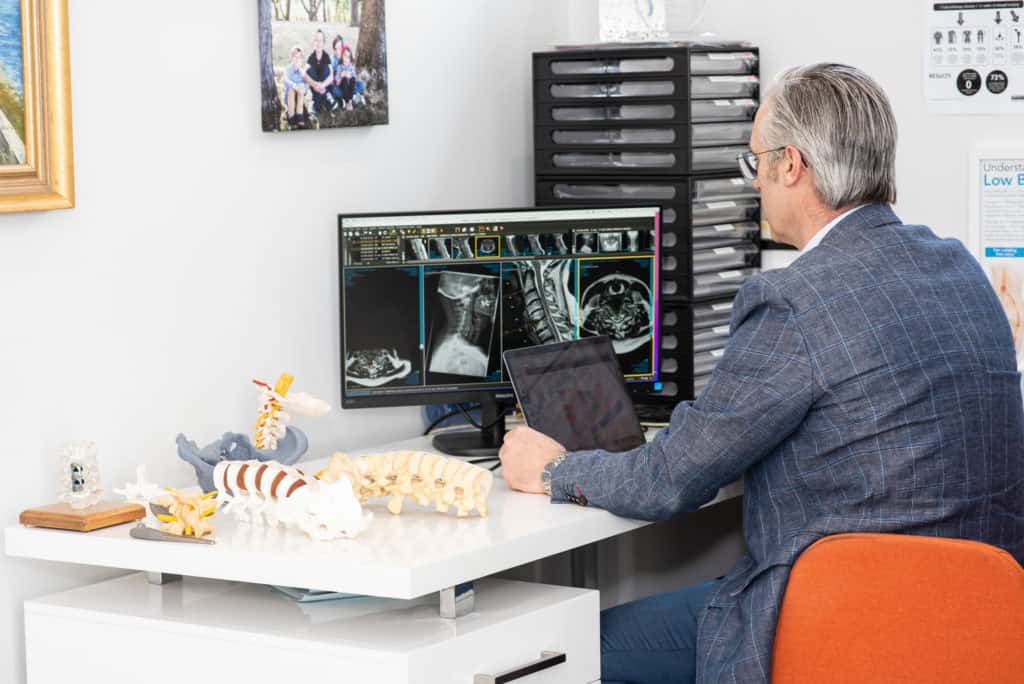
Your spinal discs are small, flat cushions that sit between your vertebrae, the bony building blocks that form your spinal column. There are 23 discs in total:
- 6 in your cervical spine (your neck)
- 12 in your thoracic spine (your middle back)
- 5 in your lumbar spine (lower back)
Your spinal discs have three main functions: absorbing shock, helping to hold your spine together, and enabling slight mobility in your spine.
The condition
What is a herniated disc?
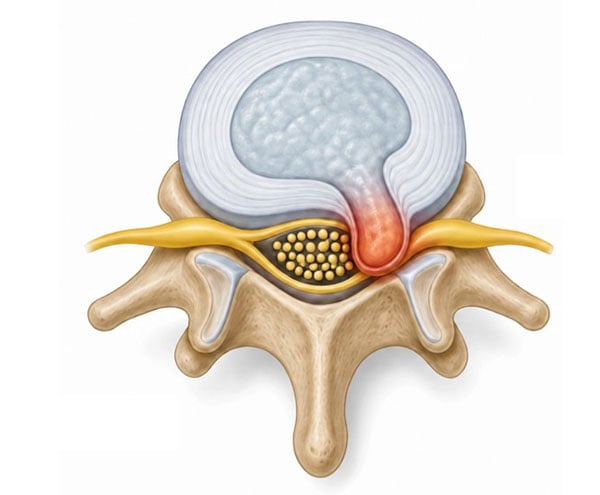
Sometimes the soft, inner part of the disc bulges out through a weak spot in the outer disc. That is known as a herniated disc — you may also hear it called a prolapsed or slipped disc.
Any of your 23 discs can prolapse but it is most likely to happen in your lower back (lumbar spine) because there is more stress there.
A prolapsed disc may press on a nerve root which can cause Sciatica.
Symptoms
What are the symptoms of a herniated disc?
Nerve root pain
A prolapsed disc may press on a nerve root, causing sudden, severe pain in your back and, depending on the nerve, possibly also in your leg. With a cervical disc prolapse the pain may radiate from your neck to your arm or shoulder.
Numbness and tingling
Along with pain, you may also experience numbness or tingling along the path of the affected nerve.
No symptoms at all
Sometimes you have no symptoms from a prolapsed disc and only discover it when it appears on a spinal scan ordered for a different reason.
Causes
What causes a disc prolapse?
Age-related degeneration
Makes your discs less flexible and more prone to tearing after even a small strain.
Your occupation
A physically demanding job involving a lot of lifting, bending, pushing and twisting puts you at greater risk.
Being overweight
Places extra stress on the discs in your lower back.
Smoking
Reduces the oxygen supply to your discs, making them break down more easily.
Inherited predisposition
Some people have an inherited predisposition towards disc prolapse.
Prolapse vs herniation
It is a difference of degree. In a prolapse the nucleus pushes through a weak spot but the outer annulus remains intact. In a herniation the inner part pushes completely through the annulus and squeezes out.
Treatment
Herniated disc treatment.
Treating a prolapsed disc depends on which disc is involved, which nerves (if any) are affected and how severe the pain is.
You may find that the symptoms gradually ease over several weeks, helped by over-the-counter painkillers and physiotherapy. If that does not work, you may try corticosteroid injections or muscle relaxing medication.
If your symptoms persist, you are in severe pain or your nerves are significantly affected, then it may be necessary to consider surgery.
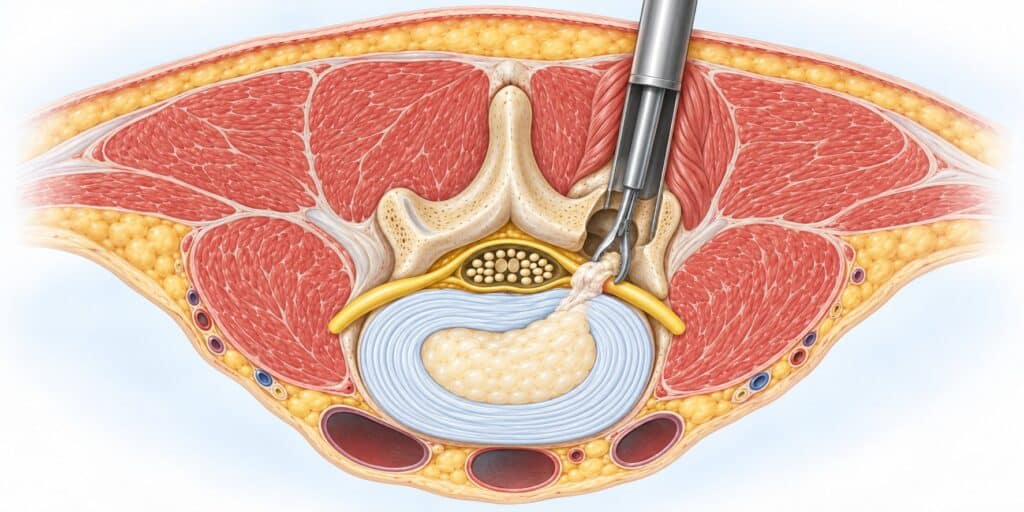
Our care pathway is designed to ensure you only progress to spinal surgery if you really need it. If you do, the usual operation is a microdiscectomy or endoscopic discectomy — minimally invasive surgery through a small incision to remove the herniated portion of the disc and take the pressure off your nerve.
Living with back, neck or joint pain?
Dr David Edis and the team at Victorian Orthopaedic Spine Service will assess your symptoms, explain your diagnosis and recommend the treatment that best suits you.
Get in touch
Contact our rooms.
Our reception team will help you arrange a consultation, answer questions about your referral and let you know what to bring on the day.
Reception hours: Monday to Thursday 9am–4.30pm, Friday 9am–2pm
Response time: within 1–2 business days
Preparing for your appointment →
Referrals
A current GP or specialist referral is required.
Request a consultation
Send us your details and our reception team will be in touch. We aim to reply within 1–2 business days. Fields marked with an asterisk (*) are required.
All information is general in nature. Patients should consider their own personal circumstances and seek a second opinion. Any surgical or invasive procedure carries risks.