Conditions treated
Spinal stenosis.
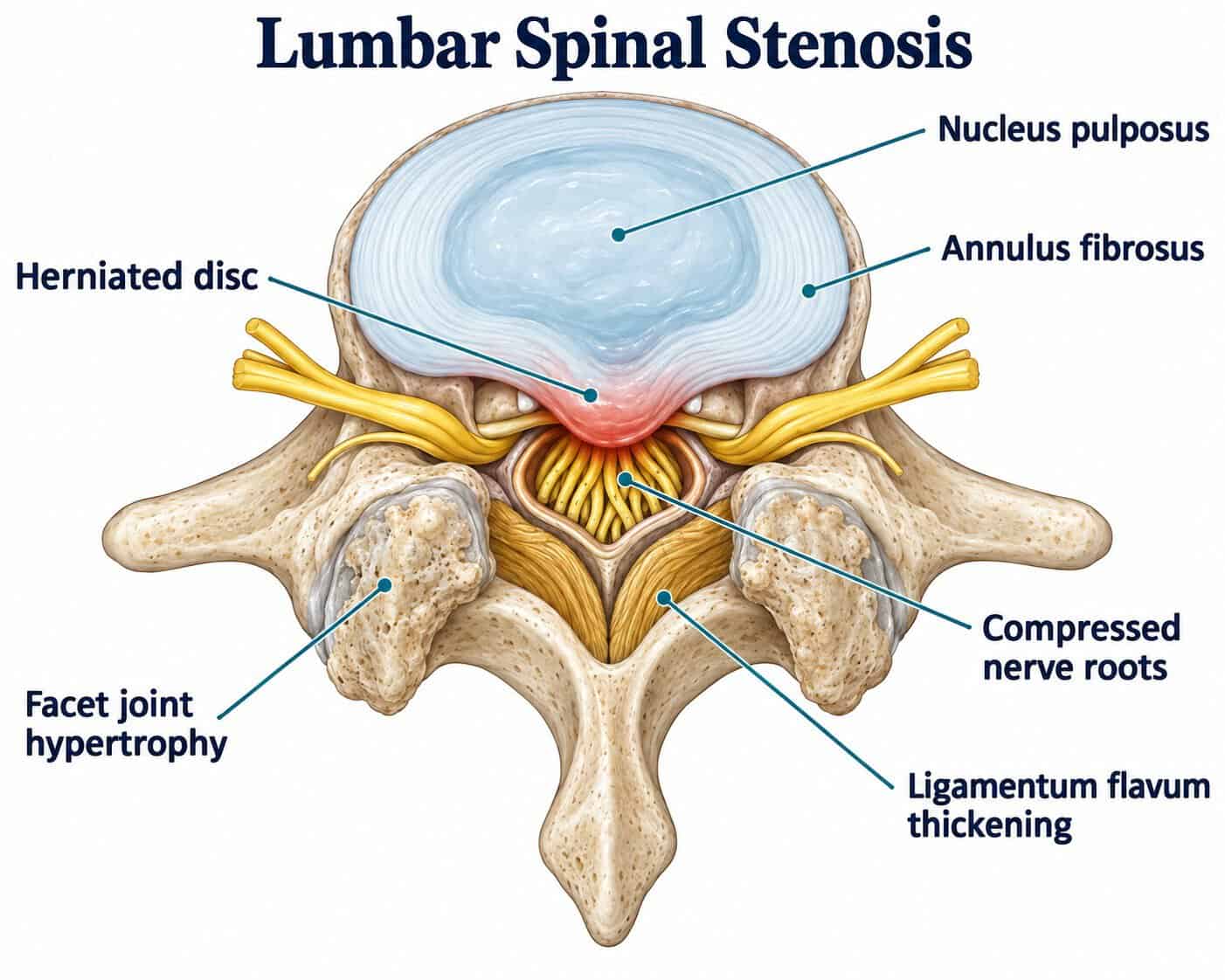
Spinal stenosis is a condition of the spine where the spinal cord or spinal nerve roots are compressed in the spinal canal. Stenosis means tightening — when the canal is tight, the nerves get compressed.
Overview
What is spinal stenosis?
This refers to a condition of the spine where the spinal cord or spinal nerve roots are compressed in the spinal canal. There are a number of different syndromes depending on the location of the nerve compression.
When the canal is tight the nerves get compressed and the conduction of electrical impulses is slowed, leading to weakness and poor sensory feedback to the brain. The compression of the nerves also causes pain that is felt in the legs where the nerve supplies an area of skin.
In most cases the cause is benign and the condition progresses slowly with time. Uncommonly there can be more rapid progression of the pain and disability associated with this condition.
Most common subtype
Lumbar canal stenosis.
This is the most common subtype and is usually due to age-related degenerative changes in the spine that lead to disc bulging and facet joint swelling, which combine to compress the nerve roots of the cauda equina in the lumbar canal. The condition can vary in severity from only occasional symptoms to very severe disabling pain that makes standing and walking very difficult.
Most patients complain of intermittent pain in the legs that may be associated with pins and needles or numbness. The symptoms tend to be worse when standing or walking and can improve with sitting or bending forward.
Sometimes the legs can just feel heavy or weak, and in severe cases there is loss of co-ordination and balance. In many cases there is no significant back pain — for most patients the leg pain is more severe.
Related patterns
Stenosis with other conditions.
Degenerate spondylolisthesis and spinal stenosis
A subgroup of patients also have spondylolisthesis due to severely worn facet joints. There is often a history of mechanical back pain — worse with standing and walking, better with rest. The condition is often progressive and may eventually require both decompression and stabilisation with surgery.
Degenerative scoliosis and spinal stenosis
These patients can have a more severe level of symptoms with both back and leg pain. The neurological compression is often worse in the foramina where the dorsal root ganglion resides, and this can be particularly painful.
Treatment
Treatment options.
Treatment options for spinal stenosis vary depending on the severity and duration of symptoms.
Activity modification
For many patients simple measures like modification of activity or using a walking aid can help to relieve symptoms enough.
Epidural steroid injection
Sometimes cortisone injections into the spinal canal can be used to relieve symptoms.
Posture and core exercises
Posture advice and exercises to strengthen the abdominal (core) muscles can also be useful to improve symptoms and function.
Analgesic medication
Medication can be trialled and may consist of paracetamol, NSAIDs, or nerve modulating agents.
Laminectomy
Surgery to decompress the nerves is used when simple measures fail to adequately relieve the symptoms or if neurological deterioration is evident.
Laminectomy and fusion
Where there is associated instability, the spine may be stabilised at the same time as the decompression.
Surgery explained
Decompression laminectomy.
Decompression laminectomy is the most common operation performed and gives relief by making more room for the nerves in the spinal canal.
Wide decompression is the traditional technique, but more recently surgeons perform less aggressive surgery that mainly removes the thickened soft tissue and part of the facet joint rather than the entire lamina. Sometimes the prolapsed disc may also be removed if that is contributing to the stenosis. This is termed selective laminectomy and preserves much of the bone covering the spinal canal. In severe cases, however, it may be necessary to perform wide decompression. Both types of operation are effective at relieving the leg pain associated with spinal stenosis.
If there is associated instability of the spine, such as spondylolisthesis or severe scoliosis, the surgeon may decide to stabilise the spine at the same time as the decompression. There are many different fusion techniques that typically involve some form of bone grafting and often a device for internal fixation.
Living with back, neck or joint pain?
Dr David Edis and the team at Victorian Orthopaedic Spine Service will assess your symptoms, explain your diagnosis and recommend the treatment that best suits you.
Get in touch
Contact our rooms.
Our reception team will help you arrange a consultation, answer questions about your referral and let you know what to bring on the day.
Reception hours: Monday to Thursday 9am–4.30pm, Friday 9am–2pm
Response time: within 1–2 business days
Preparing for your appointment →
Referrals
A current GP or specialist referral is required.
Request a consultation
Send us your details and our reception team will be in touch. We aim to reply within 1–2 business days. Fields marked with an asterisk (*) are required.
All information is general in nature. Patients should consider their own personal circumstances and seek a second opinion. Any surgical or invasive procedure carries risks.