
Conditions treated
Sciatica
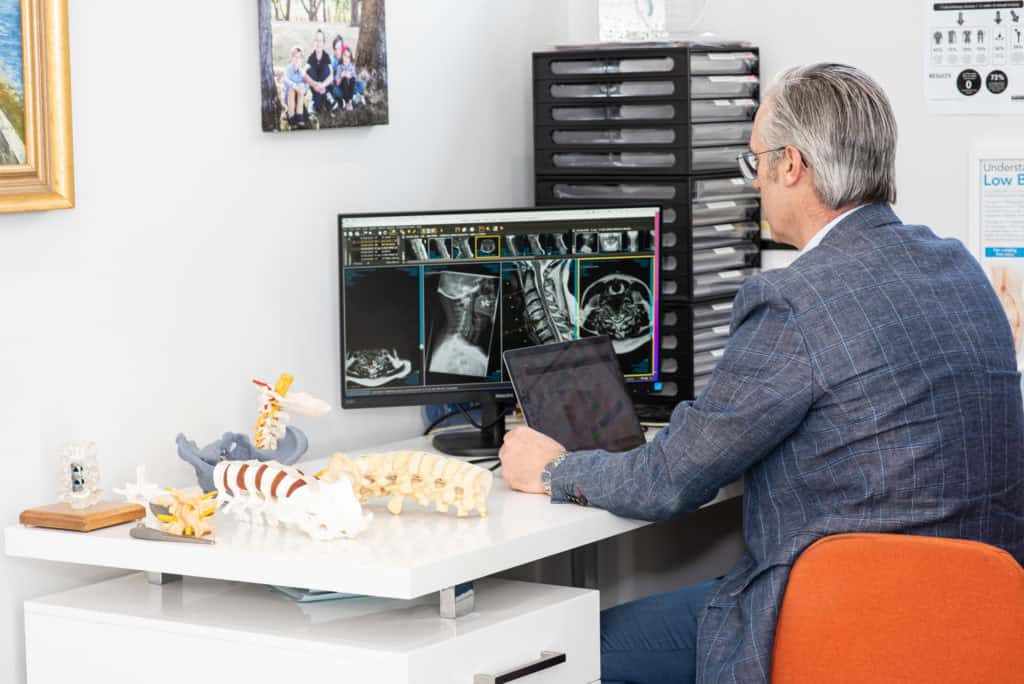
Sciatica is a common condition that affects many Australians, and varies in degrees of severity. At Victorian Orthopaedic Spine Service, Dr David Edis provides a range of treatment options including non-surgical and surgical.
Overview
What is sciatica?
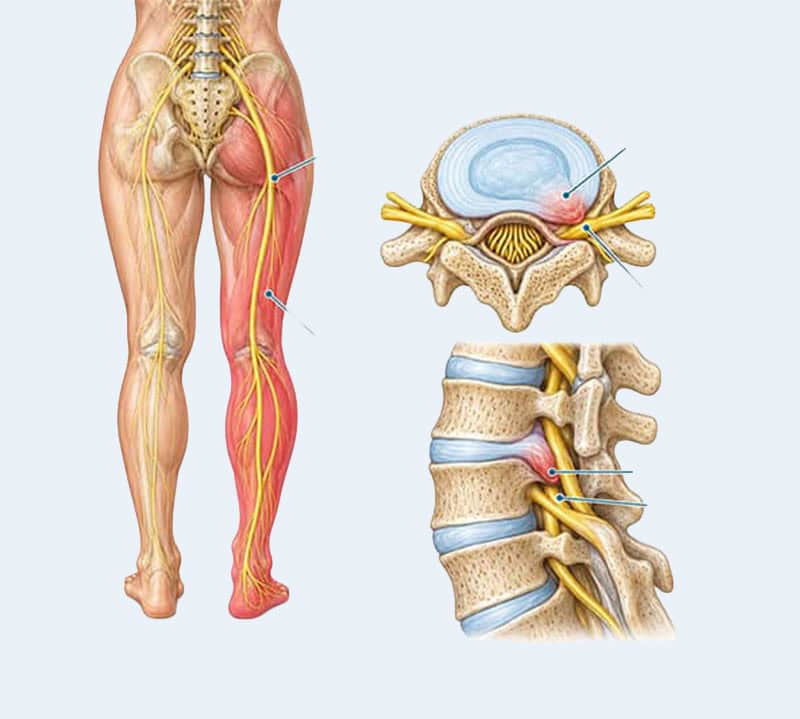
Sciatica is a term to describe pain that radiates from the back or buttock area and down the leg and into the foot or toes. The pain originates in the lower spine where the nerve roots (L4, L5 or S1) that make up the sciatic nerve can be irritated by pressure or inflammation.
Although the pathology is in the spine the pain is often worse in the leg along the course of the dermatome for the given nerve root. The medical term is radiculitis or radiculopathy of a specific nerve root and is more precise.
Sciatica is most often caused by a herniated disc — read more about herniated discs and how they are treated.
Causes
What causes sciatica?
The commonest cause of radiculopathy is acute intervertebral disc prolapse (herniated disc) that leads to both pressure on the nerve root as it deviates around the bulging disc and a strong chemical inflammatory reaction that also irritates the nerve root.
Other causes of nerve root compression can cause radiculopathy and include facet joint cysts, foraminal stenosis, nerve sheath tumours, and rarely spinal tumour or infection.
Timeframe
How long does it last?
Disc protrusions, the commonest cause of radiculopathy, usually (90%) resolve spontaneously over 6-12 weeks. The pain is often very severe in the first few days and weeks but gradually resolves with the passage of time.
Pain in the leg is often accompanied by pins & needles or parasthesia and even numbness in the same area. Sometimes the muscles supplied by the affected nerve root can be weaker than usual. In severe cases there is paralysis of the muscles. The sensory symptoms often resolve but this may be delayed until long after the pain improves.
In 5-10% of cases the pain persists beyond the usual timeframes and can lead to significant disability. In these cases it is important to seek a diagnosis and consider surgical management if a reversible cause can be found on imaging.
Diagnosis
How is sciatica diagnosed?
In most cases the clinical history and physical examination is enough for your doctor to make the diagnosis. If the pain is difficult to control, does not resolve in an appropriate timeframe or there is severe weakness, then imaging is indicated.
Plain X-ray
Not generally helpful for diagnosis on its own, but may give information that complements CT or MRI.
CT scan
Allows cross-sectional and multi-planar reconstructions so spine structures can be studied in detail. The disc prolapse can usually be seen.
MRI
The modality of choice for spinal disorders. Gives exquisite detail of nerves, discs and soft tissue, and uses no ionising radiation.
Bone scan
Nuclear medicine bone scans are sometimes used to supplement diagnosis in spinal disorders, but are typically not helpful in radiculopathy.
Treatment
Non-surgical treatment options.
Most cases of sciatica settle without surgery. Treatment focuses on controlling pain while the nerve recovers, and on keeping you moving.
Posture and positioning
Many patients find positions of relative comfort even when pain is severe. Bending the legs reduces stretch on the sciatic nerve; prone lying helps others.
Massage and gentle manipulation
Can provide short-term relief in the acute setting. Aggressive manipulation or extreme posturing is not recommended.
Simple analgesics
Regular paracetamol and/or codeine should be the first line of treatment because they are safe and have minimal side effects.
Narcotic painkillers
Still have a role in acute radiculopathy, but carry side effects and concerns about tolerance and dependence with longer use.
Anti-inflammatories and cortisone
NSAIDs and oral steroid medication can reduce the chemical inflammatory reaction around the nerve root.
Muscle relaxants and nerve stabilisers
Used to settle muscle spasm and calm an irritated, hypersensitive nerve. All medication should be taken under your doctor’s supervision.
Persistent pain
Why does pain persist in some cases?
The natural healing process after acute disc prolapse is one of acute inflammation, followed by digestion of the disc by macrophage immune cells and then healing by scar tissue. This process can go awry at any stage for many different reasons that are not fully understood.
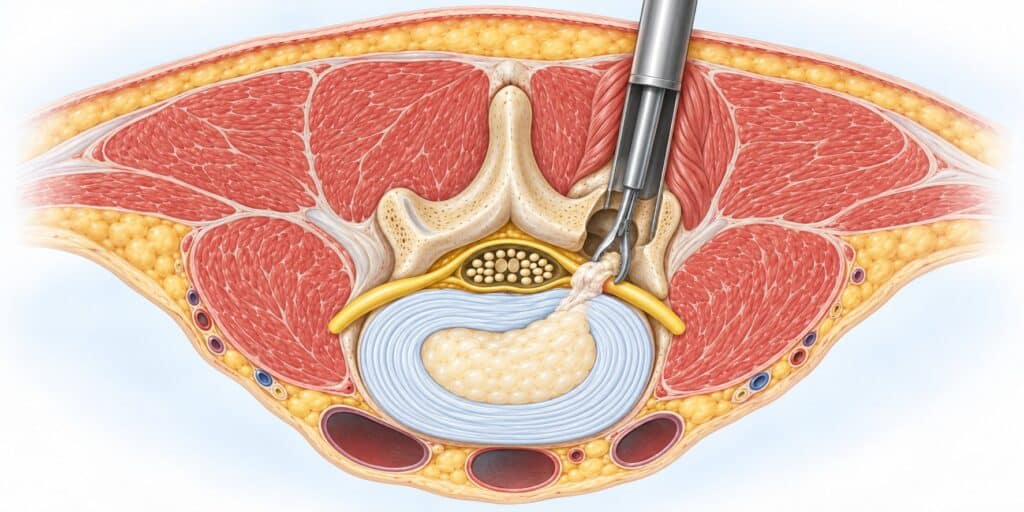
For some patients, the disc prolapse does not fully resolve and there remains persistent stretching of the nerve. In these cases, removing the disc fragment and releasing the nerve — a microdiscectomy or endoscopic discectomy — can lead to rapid resolution of the nerve pain.
Patients who stay gently active during the acute phase generally do better than those who rest for days on end. Reassuring, realistic messages matter: pain that is severe is still likely to improve, and it is safe to keep moving.
Living with back or leg pain?
Dr David Edis and the team at Victorian Orthopaedic Spine Service will assess your symptoms, explain your diagnosis and recommend the treatment that best suits you.
Get in touch
Contact our rooms.
Our reception team will help you arrange a consultation, answer questions about your referral and let you know what to bring on the day.
Reception hours: Monday to Thursday 9am–4.30pm, Friday 9am–2pm
Response time: within 1–2 business days
Preparing for your appointment →
Referrals
A current GP or specialist referral is required.
Request a consultation
Send us your details and our reception team will be in touch. We aim to reply within 1–2 business days. Fields marked with an asterisk (*) are required.
All information is general in nature. Patients should consider their own personal circumstances and seek a second opinion. Any surgical or invasive procedure carries risks.