
Conditions treated
Adjacent segment disease.
Adjacent segment disease refers to new spinal symptoms above or below the site of previous spinal surgery. This is a real concern for both patients and spine surgeons.
Anatomy
What is a segment?
The 33 vertebrae in your spine make up five distinct segments. From top to bottom those are:
- Cervical (neck), which has 7 vertebrae known as C1 to C7
- Thoracic (middle back), which has 12 vertebrae known as T1 to T12
- Lumbar (lower back), which has 5 vertebrae known as L1 to L5
- Sacrum, a triangle-shaped bone that connects to your hips
- Coccyx (tailbone), four fused vertebrae at the bottom of your spine that connect to your pelvic floor
If you are diagnosed with adjacent segment disease, it means you have developed new spinal symptoms in an area adjacent to a site of previous spinal surgery.
Causes
What causes adjacent segment disease?
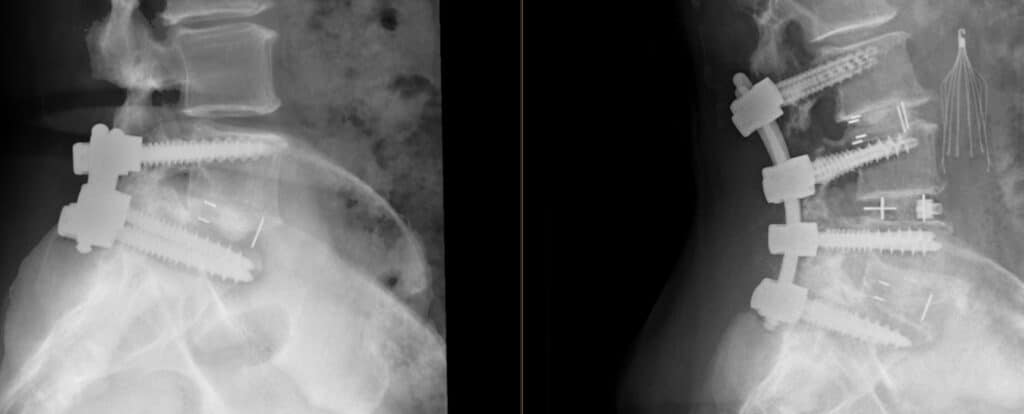
Adjacent segment disease can be the result of the normal progression of a degenerative spinal condition, or of spinal surgery that has successfully stabilised your spine but resulted in the segments next to the surgery site experiencing greater stress.
Spinal fusion surgery joins together two or more vertebrae to help improve your spine stability, correct any deformity, and ease your back pain. Sometimes, though, stiffening certain segments places additional stress and strain on the adjacent segments.
Treating a degenerative spinal condition is sometimes a bit like putting out spot fires. Spinal fusion surgery may succeed in relieving the initial symptoms in that area of your spine — but your spine is still degenerating. Limiting movement in one section can sometimes accelerate degeneration in an adjacent segment.
Prevention
How to Prevent Adjacent Segment Disease.
The most effective strategy is achieving optimal spinal alignment at the time of the index surgery, so that the forces normally transmitted to the adjacent segment are neutralised rather than amplified. Advanced surgical planning tools allow us to understand each patient’s individual spinal alignment and determine how to best optimise alignment when performing a fusion.
Protecting the segments above and below the fusion also depends on preserving the structures that support them. Minimally invasive techniques help avoid unnecessary damage to the adjacent facet joints and surrounding muscles during surgery. Accurate screw placement — guided by computer navigation or robotics — further reduces the risk of inadvertent injury to these adjacent structures, helping to protect long-term spinal health beyond the level of fusion.
Treatment
Treatment interventions.
Any further surgery must be meticulously planned so that the underlying problem can be addressed and spine alignment is balanced to minimize the chance of further surgery. General Health and bone quality optimization are also important to address during the planning phase. Although having to undergo revision surgery can be concerning for patients, the outcomes can be a dramatic improvement in function and in most cases improved pain relief.
Non-surgical treatment
Usually we begin by recommending conservative measures such as physiotherapy or steroid injections, in the hope of avoiding the need for revision surgery.
Surgical treatment
If conservative measures do not provide sufficient relief we may recommend revision surgery. Such surgery can have many technical difficulties and does involve more risk than primary spine surgery.
Revision surgery
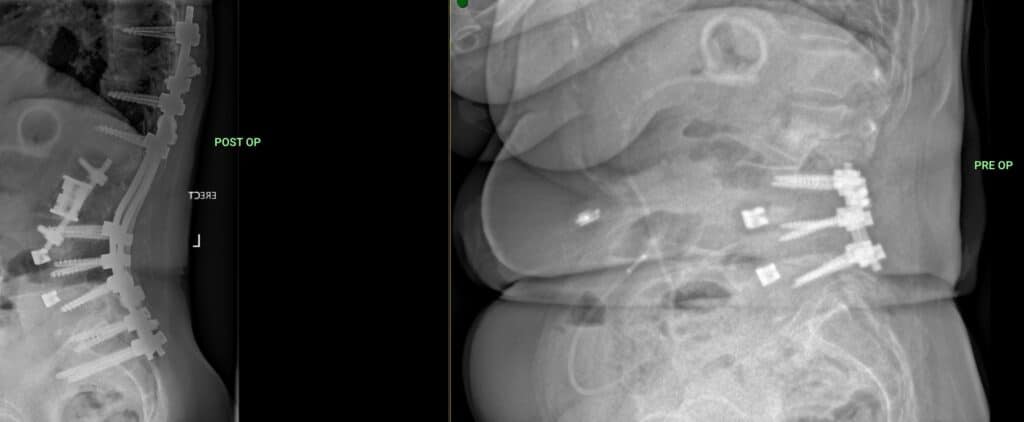
What extensive revision surgery may involve.
- Decompression of nerves
- Removal of implants
- Correction of any spinal deformity
- Reconstruction with new implants
- Bone grafting
Any revision surgery needs to be carefully planned and customised to your unique needs.
If you have ongoing pain after a previous back surgery, please contact the Victorian Orthopaedic Spine Service. Dr David Edis will explore your history and, if he diagnoses adjacent segment disease, he can advise you on your treatment options and customise a solution tailored to your needs.
Living with back, neck or joint pain?
Dr David Edis and the team at Victorian Orthopaedic Spine Service will assess your symptoms, explain your diagnosis and recommend the treatment that best suits you.
Get in touch
Contact our rooms.
Our reception team will help you arrange a consultation, answer questions about your referral and let you know what to bring on the day.
Reception hours: Monday to Thursday 9am–4.30pm, Friday 9am–2pm
Response time: within 1–2 business days
Preparing for your appointment →
Referrals
A current GP or specialist referral is required.
Request a consultation
Send us your details and our reception team will be in touch. We aim to reply within 1–2 business days. Fields marked with an asterisk (*) are required.
All information is general in nature. Patients should consider their own personal circumstances and seek a second opinion. Any surgical or invasive procedure carries risks.