
Conditions treated
Facet joint arthritis.
Your facet joints might be small but they do a big job — in your lower spine they support 20% of the weight of your upper body. Like your knees and hips, they can develop arthritis.
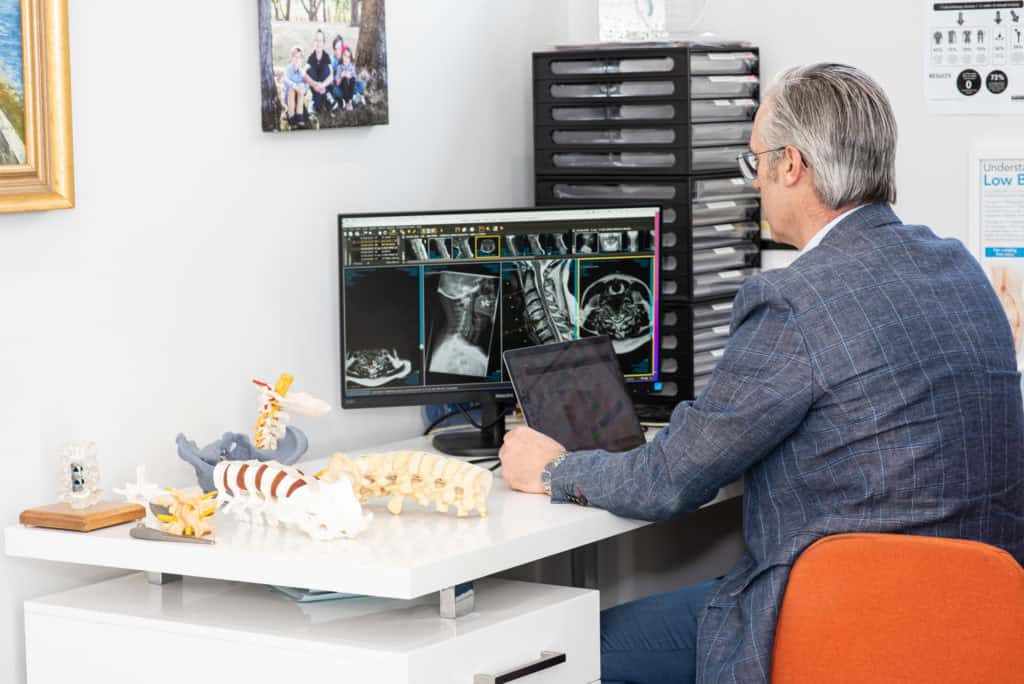
Anatomy
What are facet joints?
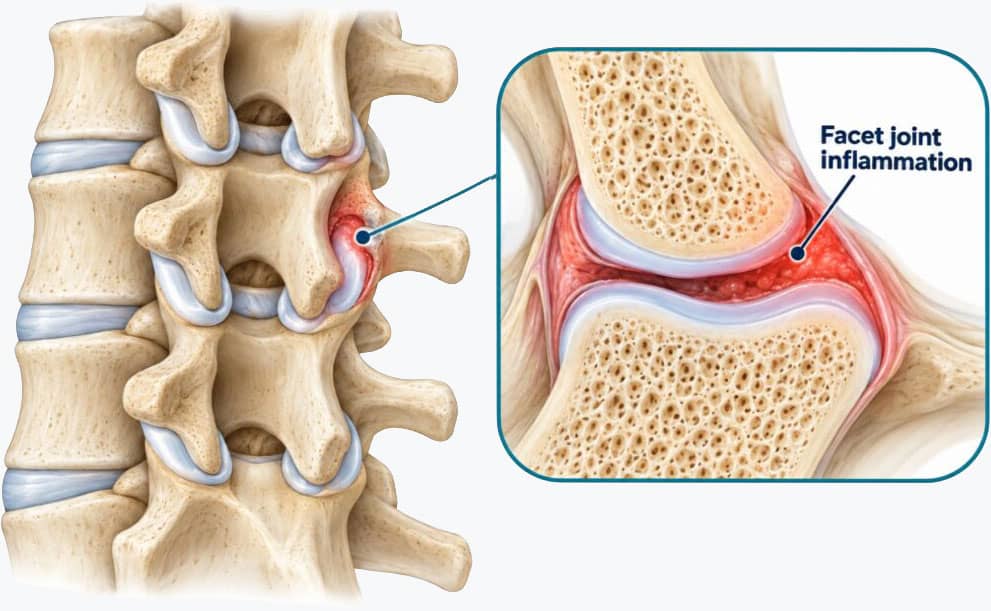
Your spine is made up of 26 building blocks known as vertebrae with a spongy, shock-absorbing disc between each one. Each vertebra has its own pair of facet joints at the back that connect it to the next vertebra. These facet joints allow you to bend, twist and stretch your spine while restricting excessive movement.
Like other synovial joints, your facet joints include a smooth glistening articular cartilage which caps the bones, a capsule of fibrous tissue that contains the joint, and an inner membrane that makes synovial fluid to lubricate the joint.
The condition
What is facet joint arthritis?
Facet joints are prone to the same conditions that affect other synovial joints. Facet joint arthritis may also be known as spinal osteoarthritis, facet joint syndrome and facet disease.
Osteoarthritis
Caused by age-related degeneration, also known as wear and tear. This is the most common form of spinal arthritis.
Rheumatoid arthritis
Caused by inflammation in the synovium of the joints.
Crystal arthropathy
Gout or pseudogout crystals can deposit in the joint and cause inflammation, swelling and pain.
Septic arthritis
A special form of arthritis caused by bacterial infection.
Causes
What causes facet joint arthritis?
Like other weight-bearing joints such as your hips and knees, your facet joints seem to show signs of wear and tear earlier than other joints. The cartilage between the joints slowly breaks down, causing inflammation and pain.
A previous injury can cause joint damage that eventually leads to spinal osteoarthritis. Obesity is another contributing factor because it places more strain on your joints, while a family history of osteoarthritis increases your risk.
Facet joint arthritis can also be a knock-on effect of degenerative disc disease. The spongy discs between each vertebra also degenerate with age, becoming flatter and less hydrated. That may contribute to facet joint arthritis by transferring pressure from the disc to the facet joint, triggering more load and cartilage damage.
Symptoms
What are the symptoms?
You may not experience any symptoms. When we image older spines for other reasons we commonly find signs of facet joint arthritis even though the patient has shown no signs of a problem.
Back pain and stiffness
Worse when the spine is extended — for example bending backwards — because that increases load on the facet joints. Bending forward often eases the pain.
Worse after inactivity
Symptoms may be worse after long periods of inactivity, or after standing or sitting. Lying down may help relieve the pain.
Nerve symptoms
Facet joint arthritis can narrow the spinal canal, putting pressure on the nerves. You may notice numbness and weakness in your limbs, balance and coordination difficulties, or shooting pain, burning and tingling in your arms or legs.
Diagnosis
How is facet joint arthritis diagnosed?
To reach a diagnosis, your doctor may:
- Ask about your family history and symptoms like back pain, numbness or weakness
- Examine you to check for tenderness, limited range of motion or swelling in your back
- Order imaging tests like an X-ray, CT or MRI to look for bone spurs, bone damage or cartilage loss
- Order a nuclear medicine bone scan or SPECT to isolate which facet joint is most arthritic and help target treatment
- Take a blood test to rule out other conditions that can cause similar symptoms
- Test the fluid in your joints to see if your symptoms are caused by arthritis, gout or an infection
Facet joint arthritis is a progressive disease, meaning symptoms tend to get worse as time goes on. While it can cause pain and stiffness, it might not be responsible for all the back pain you feel — often it is a contributory cause rather than the whole story.
Treatment
How do you treat facet joint arthritis?
Treatment aims to reduce the load on the affected joints and manage pain. Most people do not need surgery.
Exercise and core control
Exercises to strengthen supporting muscles help share the load. Your doctor or physiotherapist may recommend core muscle strengthening and control exercises.
Injections
Facet joint blocks or cortisone injections can provide relief for a few weeks to a few months — best results come when you are also diligent with your exercises.
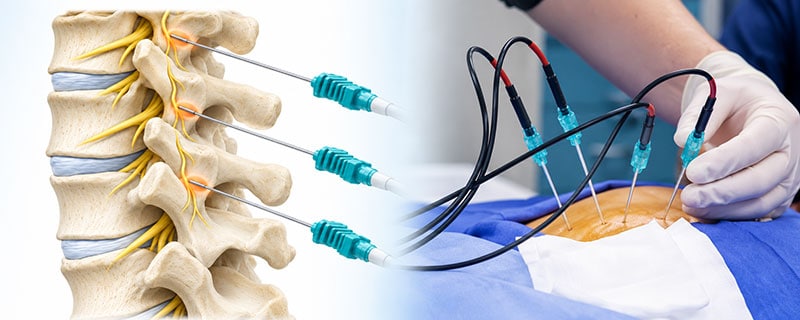
Radiofrequency denervation
More recently, radiofrequency denervation of the facet joints has been used to reduce facet joint pain, and for some people seems to help for a few months to a year.
Surgery
Sometimes your arthritis symptoms may be complicated by spinal stenosis or spondylolisthesis. If you have one of those conditions and severe symptoms, then surgery may be the most appropriate treatment.
Our care pathway
Carefully designed to ensure you only progress to surgery if you really need it — we prefer to try conservative treatments first.
Getting seen
If you are dealing with back pain, stiffness, weakness or numbness then it is important to get the right diagnosis. You will need a referral from your GP first.
Living with back, neck or joint pain?
Dr David Edis and the team at Victorian Orthopaedic Spine Service will assess your symptoms, explain your diagnosis and recommend the treatment that best suits you.
Get in touch
Contact our rooms.
Our reception team will help you arrange a consultation, answer questions about your referral and let you know what to bring on the day.
Reception hours: Monday to Thursday 9am–4.30pm, Friday 9am–2pm
Response time: within 1–2 business days
Preparing for your appointment →
Referrals
A current GP or specialist referral is required.
Request a consultation
Send us your details and our reception team will be in touch. We aim to reply within 1–2 business days. Fields marked with an asterisk (*) are required.
All information is general in nature. Patients should consider their own personal circumstances and seek a second opinion. Any surgical or invasive procedure carries risks.