
Conditions treated
Failed back surgery.
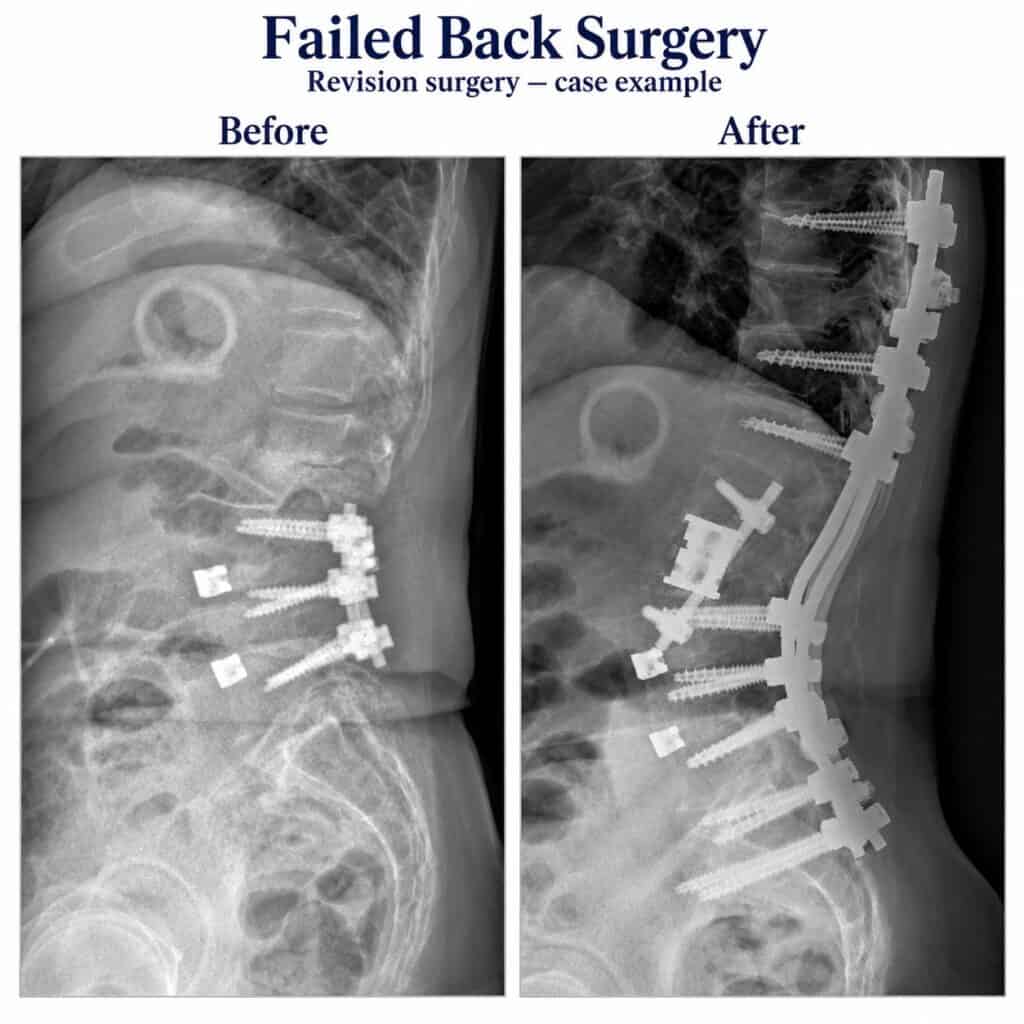
Failed back surgery encompasses many conditions and complications after surgery, and is not a single entity. This unfortunate term refers to any person with ongoing significant pain and disability after having spinal surgery.
Overview
What is failed back surgery?
The term implies that surgery has been done and that there is no ongoing mechanical explanation for ongoing symptoms.
For many patients there is a reasonable explanation of why their surgery has not relieved their pain, and these known complications need to be looked for before a patient is given this label. Some of these complications are reversible, but may require specialist evaluation with special tests to make the correct diagnosis.
Differential diagnosis
Conditions to look for.
Adjacent segment degeneration
New degeneration in the level above or below a previous fusion.
Non-union of a fusion
The vertebrae have not grown together as intended after fusion surgery.
Residual or recurrent stenosis
Narrowing of the canal that was not fully relieved, or that has returned.
Infection
Post-operative infection of the wound, disc or bone.
Fracture
A new fracture at or near the operated level.
Loss of fixation
Loosening or failure of implants placed at the original surgery.
Neural compression outside the spine
For example meralgia paraesthetica, where a nerve is compressed away from the spine.
Non-spinal causes
Neuropathies and spinal cord disease such as MS, or non-spinal causes of back and leg pain such as hip arthritis, kidney disease, abdominal aortic aneurysm or arterial stenosis.
Persistent pain
Chronic or persistent pain syndrome.
Some patients do have an element of central neuro-sensitisation that contributes to the ongoing pain experience despite apparently successful surgery, and this also needs to be considered.
It is increasingly understood that pain is best understood as more than just a biological phenomenon. Social and psychological factors contribute to persistent pain and may also need to be addressed in a successful management plan.
This condition is a serious concern for Dr David Edis and his team. Through both pre and post surgery treatment we attempt to minimise all possible causes.
Living with back, neck or joint pain?
Dr David Edis and the team at Victorian Orthopaedic Spine Service will assess your symptoms, explain your diagnosis and recommend the treatment that best suits you.
Get in touch
Contact our rooms.
Our reception team will help you arrange a consultation, answer questions about your referral and let you know what to bring on the day.
Reception hours: Monday to Thursday 9am–4.30pm, Friday 9am–2pm
Response time: within 1–2 business days
Preparing for your appointment →
Referrals
A current GP or specialist referral is required.
Request a consultation
Send us your details and our reception team will be in touch. We aim to reply within 1–2 business days. Fields marked with an asterisk (*) are required.
All information is general in nature. Patients should consider their own personal circumstances and seek a second opinion. Any surgical or invasive procedure carries risks.