
Conditions treated
Cauda equina syndrome.
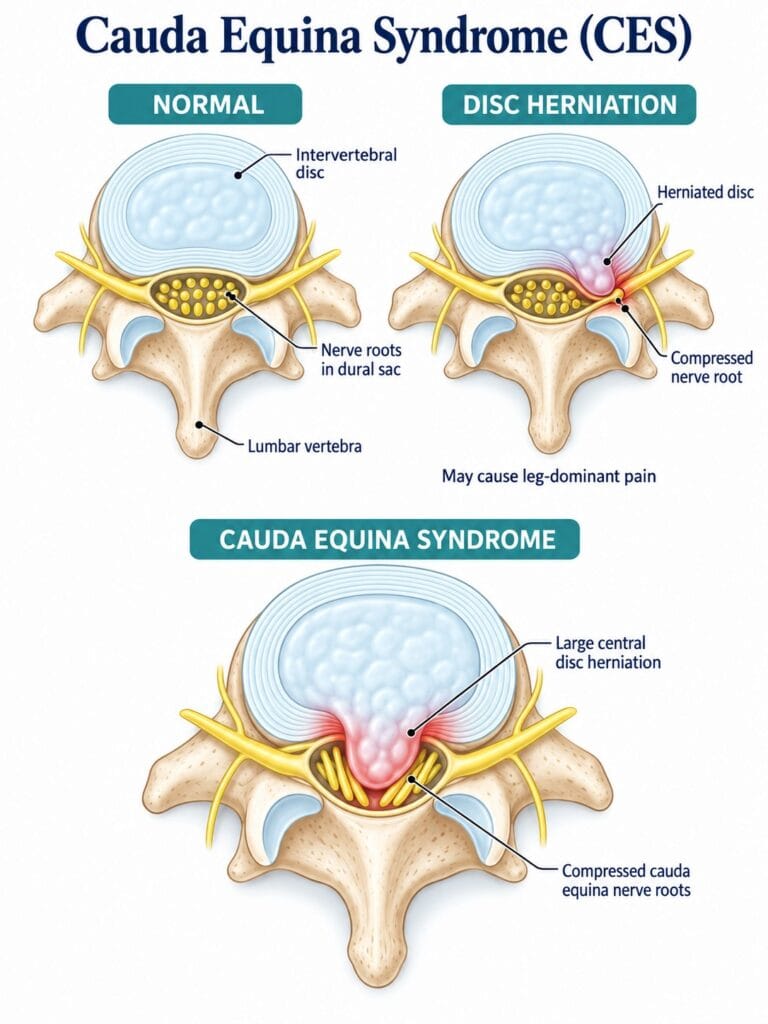
The cauda equina is the continuation of the nerves given off from the lower spinal cord, destined for the lower limb and pelvis. Cauda equina syndrome refers to compression of those nerves, affecting movement and sensation in your lower body. It is a serious condition that needs urgent surgical treatment.
Overview
What is cauda equina syndrome?
Cauda equina syndrome is a rare condition involving compression of the lower spinal nerve roots in the lumbar canal known as the cauda equina. The spinal cord only reaches to the L1 level in most people.
This leash of nerves sits at the lower end of your spinal canal and looks a bit like a horse tail — which is the meaning of cauda equina in Latin.
The nerves in the cauda equina send messages to your pelvic organs, legs and feet. Cauda equina syndrome happens when those nerves are severely compressed and can no longer communicate easily with your lower body.
Warning signs
Signs and symptoms.
These symptoms — particularly numbness and incontinence — should always be investigated quickly through an urgent appointment with your GP or at your local emergency department.
Severe back pain
Sudden and severe pain in the lower back.
Numbness and weakness
Numbness and weakness in the lower back and legs.
Loss of bladder and bowel control
A change in bladder or bowel function is a red flag symptom.
Saddle numbness
Numbness in the bottom and perineum — the area around your vagina or scrotum.
How rare is it?
Rest assured, cauda equina syndrome is rare. It is expected that in one year only one person per 100,000 will develop the condition.
Causes
What causes cauda equina syndrome?
Cauda equina syndrome is caused by severe compression of your cauda equina. Many things can cause that compression.
Massive disc prolapse
A large prolapse can fill the canal and compress the whole nerve bundle.
Spinal tumours or lesions
One of the most common reasons is cancer elsewhere metastasising to the spine, growing into the canal and compressing the nerve roots. Sometimes it may be the first presentation of underlying cancer.
Spinal haemorrhage
Bleeding within the spinal canal, including postoperative haematoma after previous lower back surgery.
Fractures and dislocation
Significant burst fractures or dislocation of the lumbar spine, including in children and adults after severe injury.
Spinal stenosis
Narrowing of the spinal canal in the lower back, often from age-related degeneration.
Diagnosis and treatment
Urgent imaging, urgent surgery.
MRI
MRI of the spinal cord and nerve roots is the usual investigation and will demonstrate most clearly if compression is present, and the underlying cause.
CT or myelogram
A CT with or without myelogram is another option if MRI is not available, and can show if the cauda equina is compressed.
Emergency surgery
Cauda equina syndrome is treated through emergency surgery to relieve pressure on the nerves. The exact type of surgery depends on the underlying condition causing the compression.
Outlook
What is the outlook after cauda equina syndrome?
With timely diagnosis and surgery, normal function can often be restored.
However, if there is a significant delay before decompression surgery happens, cauda equina syndrome can cause permanent damage to the nerves that control your lower body. That can lead to incontinence, leg weakness and numbness, and sexual dysfunction.
Dr David Edis is an experienced orthopaedic surgeon who has performed many decompression surgeries in over 20 years of practice. He regularly participates in the spinal on-call roster for Mulgrave Private and Peninsula Private hospitals. If you have symptoms of cauda equina syndrome, your first step is to see a doctor at your nearest emergency department for an urgent assessment — they can refer you on to our service.
Living with back, neck or joint pain?
Dr David Edis and the team at Victorian Orthopaedic Spine Service will assess your symptoms, explain your diagnosis and recommend the treatment that best suits you.
Get in touch
Contact our rooms.
Our reception team will help you arrange a consultation, answer questions about your referral and let you know what to bring on the day.
Reception hours: Monday to Thursday 9am–4.30pm, Friday 9am–2pm
Response time: within 1–2 business days
Preparing for your appointment →
Referrals
A current GP or specialist referral is required.
Request a consultation
Send us your details and our reception team will be in touch. We aim to reply within 1–2 business days. Fields marked with an asterisk (*) are required.
All information is general in nature. Patients should consider their own personal circumstances and seek a second opinion. Any surgical or invasive procedure carries risks.