
Conditions treated
Sagittal imbalance syndrome.
Also known as flat back syndrome or fixed positive sagittal imbalance. It occurs when the spine cannot be maintained in an upright position without significant compensation from the hips or knees.
Normal alignment
The normal shape of the spine.
The normal spine is balanced with regard to the position of the head over the pelvis. This is true for the front view (coronal plane) and the side view (sagittal plane). Scoliosis refers to an abnormal curve of the spine in the coronal plane — these curves may be balanced or imbalanced, where the head sits off to one side compared with the centre of the pelvis.
The spine has a normal curved shape in the sagittal plane. In the lumbar and cervical regions there is a concavity at the back termed lordosis, whereas in the thoracic spine there is a convexity (kyphosis) at the back.
Overall the head sits well balanced over the pelvis to neutralise the forces and the amount of work the spine muscles need to do to maintain an upright posture.
When it goes wrong
How sagittal imbalance develops.
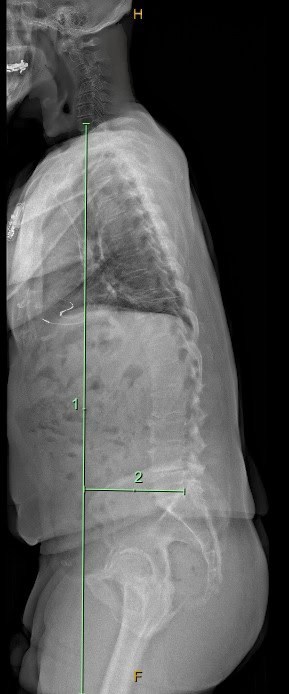
As the spine undergoes age-related changes it loses much of the normal lordosis and there is a gradual trend toward kyphosis. This occurs because of disc degeneration that leads to loss of disc height more at the front than the back, and with osteoporosis the spine can undergo spontaneous wedge fracture that also adds to the kyphosis.
This is a normal ageing process and for most people causes no major symptoms apart from the bent posture. If the hips remain mobile then most spines self-adjust by allowing extension of the pelvis through the hips.
There are other causes of positive sagittal balance, such as post-surgical cases where fusion is performed without adequate lordosis, or when the spine falls off the top of a long fusion segment due to altered stiffness and accelerated degeneration. Some patients are also born with abnormally shaped vertebrae that can lead to kyphosis in one area of the spine.
Why it hurts
Muscles working overtime.
Erector spinae overload
The spinal extensor muscles have to work overtime to bring the head and shoulders back over the pelvis in a spine with excessive forward bend. This constant activity can increase forces across the facet joints and cause degenerative arthritis.
Muscle fatigue
The erector spinae can fatigue and cause muscle aching when trying to stand and walk. If the kyphosis is stiff then the pull of the muscles will not be effective and they will fatigue more quickly.
Decompensation
If the kyphosis becomes too much for the pelvic compensation mechanisms, hips and knees must flex to allow an upright position. This leads to inefficient use of the leg muscles and fatigue there too. Walking and standing can become very difficult and exhausting.
Treatment
How is sagittal imbalance syndrome treated?
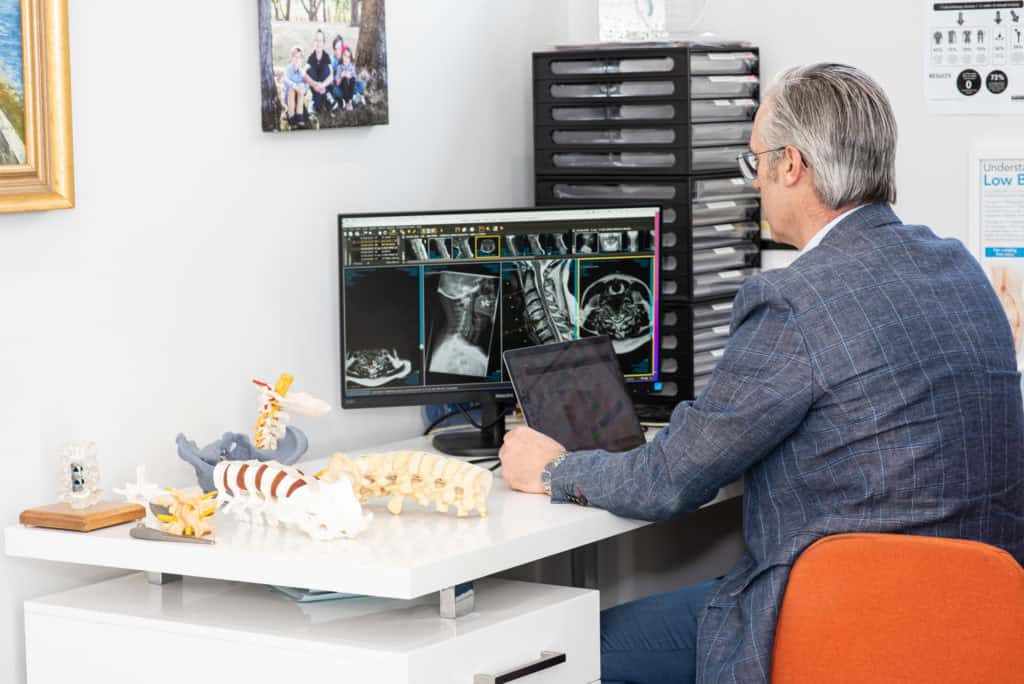
The first step in management is to recognise that there is a mechanical cause for the disabling back pain, and to document the deformity with long spinal X-rays. The size of the problem can then be appreciated.
Non-operative options include activity modification and the use of walking aids such as a stick or frame. These help share the loads through the upper limbs and reduce the strain on the spine extensor muscles. Exercises to strengthen the core muscles are prescribed, and sensible weight loss should be considered where appropriate.
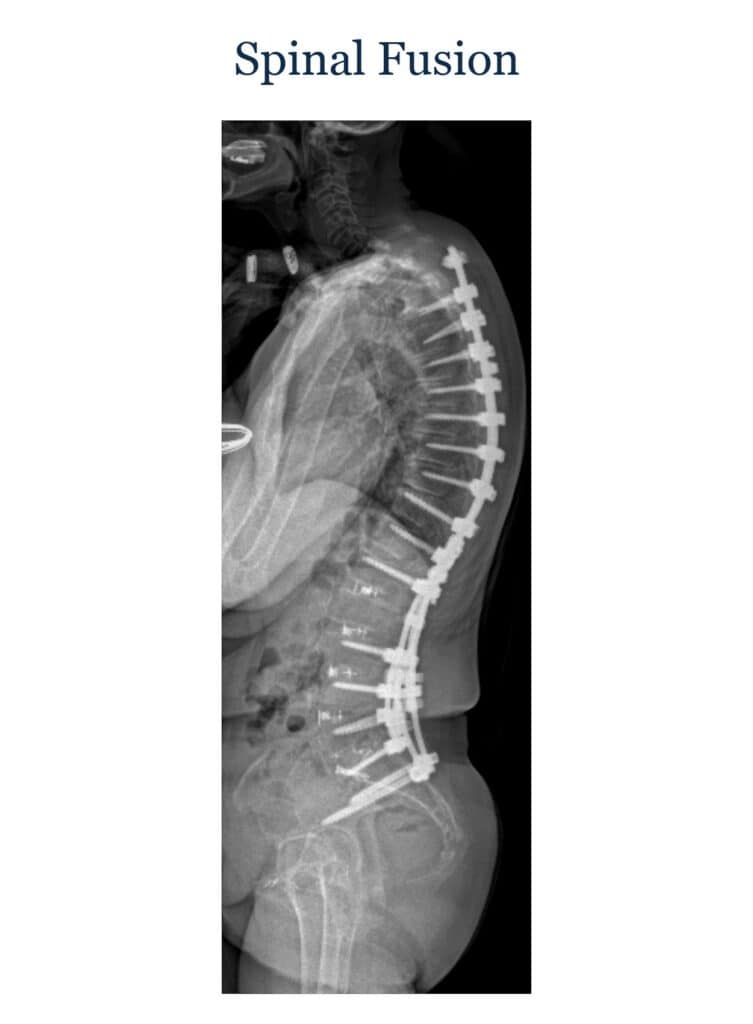
If non-operative options fail and surgery is considered, then it must be carefully planned depending on the nature of the deformity and underlying bone quality. Frequently an extension osteotomy of the spine will need to be part of the operative plan in order to increase the extension of the spine and bring the head back over the pelvis.
Living with back, neck or joint pain?
Dr David Edis and the team at Victorian Orthopaedic Spine Service will assess your symptoms, explain your diagnosis and recommend the treatment that best suits you.
Get in touch
Contact our rooms.
Our reception team will help you arrange a consultation, answer questions about your referral and let you know what to bring on the day.
Reception hours: Monday to Thursday 9am–4.30pm, Friday 9am–2pm
Response time: within 1–2 business days
Preparing for your appointment →
Referrals
A current GP or specialist referral is required.
Request a consultation
Send us your details and our reception team will be in touch. We aim to reply within 1–2 business days. Fields marked with an asterisk (*) are required.
All information is general in nature. Patients should consider their own personal circumstances and seek a second opinion. Any surgical or invasive procedure carries risks.